Explain Each Tier in the Tier List?
Learn what S, A, B, C, D, and F tiers mean, why S sits above A, how special ranks work, and when custom labels make a ranking clearer.
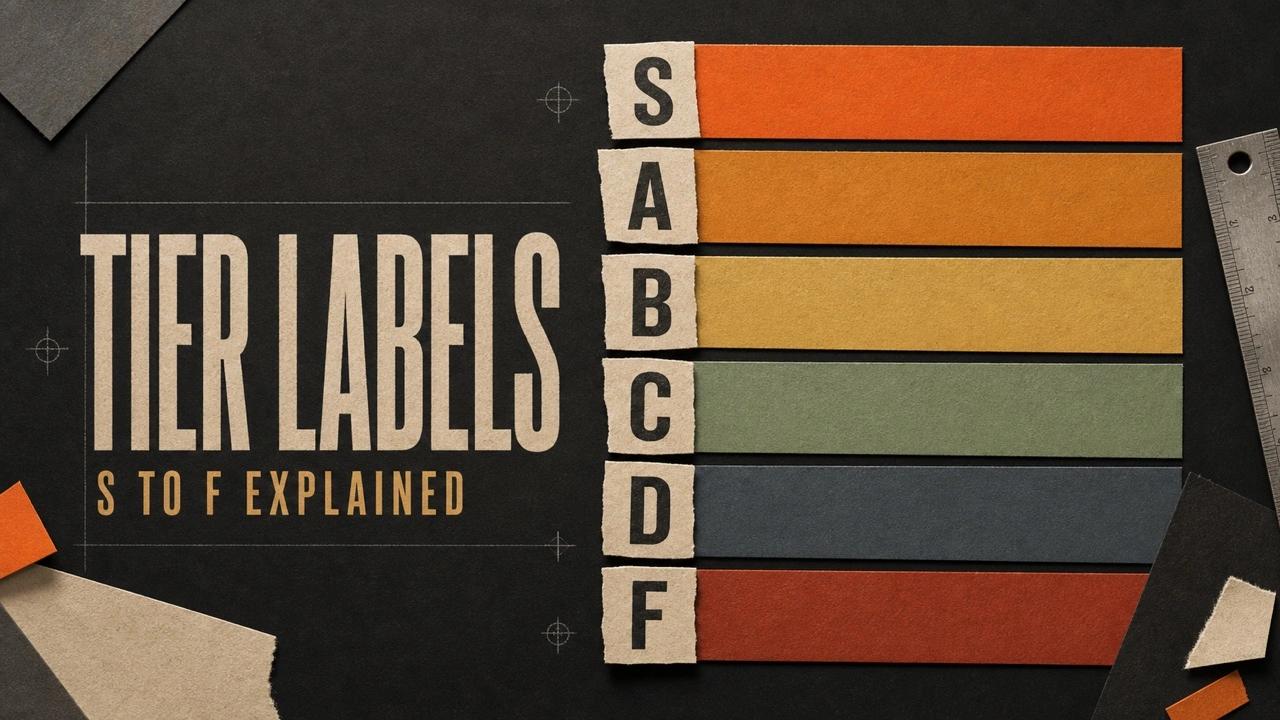
Tier lists group comparable items into rows that run from strongest or most preferred at the top to weakest or least preferred at the bottom. The familiar letter scale usually starts with S, followed by A, B, C, D, and sometimes F.
Those letters are a shared convention, not a fixed law. Their exact meaning changes with the topic. S might mean strongest in a competitive game, most enjoyable in a film list, or best value in a product comparison.
The scale works when the title defines the ranking rule and every row keeps a distinct purpose. This guide explains each common tier and shows how to change the labels without losing that clear top-to-bottom order.
What does each tier in a tier list mean?
S tier holds the exceptional top group. A tier contains excellent choices just below it. B tier is good and dependable, C tier is average or mixed, D tier is weak, and F tier is the lowest group. The topic decides whether those grades measure strength, quality, value, difficulty, or personal preference.
What does S tier mean?
S tier is the highest common rank. It is reserved for the few items that set the standard under the list's chosen rule. A competitive character might reach S because it performs well across many matchups. A favorite album might reach S because it has the strongest full listening experience.
The top row becomes less useful when too many items enter it. There is no required percentage, but S should feel selective. If nearly every strong choice reaches S, A tier has little reason to exist.
Some people read S as “super,” “special,” or “superior.” The label matters less than its position. Readers understand that S sits above A and marks a result beyond the normal top grade.
Why is S tier above A tier?
S rank became familiar through Japanese grading and game systems that needed a mark above A. Games used it for exceptional scores, rare performance, or a special class. Tier-list culture kept that order as the format spread through competitive gaming and then into wider online use.
A new reader does not need that history to understand the board. Position explains the scale: the highest row is strongest, and each row below represents a step down. Clear labels and a specific title remove the remaining doubt.
What does A tier mean?
A tier contains excellent choices that fall just short of the leading group. An A-tier item may have one meaningful limit, need a narrower situation, or lose a direct comparison with the S-tier choices.
The difference between S and A can be small. That is useful because the scale can show both exceptional and excellent results without pretending they are identical. An A-tier item is still a strong recommendation in most positive rankings.
In a preference list, A can also mean “love it, but not a personal favorite.” The title should make that personal standard clear so readers do not mistake taste for a claim about objective performance.
What does B tier mean?
B tier usually means good, solid, or above average. These choices do their job and may have clear strengths, but they also have limits that keep them below A. B is often one of the largest rows because many items are useful without being exceptional.
A B-tier game character could be effective with the right player or team. A B-tier restaurant might be a reliable choice that lacks a standout dish. The shared idea is competence with room for improvement.
B should not automatically mean “bad.” If your intended scale treats B negatively, custom labels can avoid confusion. “Good,” “Mixed,” and “Weak” communicate the judgment more directly.
What does C tier mean?
C tier is the middle of the common scale. It can mean average, situational, mixed, or acceptable. An item here may work under the right conditions while offering no strong reason to choose it first.
The middle tier needs a careful definition because readers disagree about whether C is neutral or slightly weak. A title, subtitle, or custom row name can settle that issue. “C: Fine with the right team” carries more information than the letter alone.
A crowded C tier may show that the ranking question is too broad. Split the topic or add one more useful row when the middle contains several different kinds of results.
What does D tier mean?
D tier usually marks below-average choices. These items have major limits, weak performance, low value, or little appeal under the selected ranking rule. They may still work in a narrow case, which separates D from a fully failing F tier.
A personal list can use D for “rarely choose” without calling the item objectively bad. A competitive list may use D for choices that require much more effort to match common alternatives. The reason should match the title.
Leave D empty when the item group has no truly weak choice. An honest empty row is clearer than lowering an item merely to fill the space.
What does F tier mean?
F tier is the bottom rank and usually means failing, unusable, or least preferred. It creates a stronger separation than D, so it fits lists where the weakest choices have serious problems under the ranking rule.
Not every list needs F. A casual ranking of foods, friends' suggestions, or creative work can stop at D or use a softer custom label. The scale should help the discussion without adding a harsh judgment the topic does not need.
When F is present, define the gap between D and F. D might mean “weak but usable,” while F means “avoid.” That difference keeps the last two rows from repeating each other.
What do S+, SS, and SSS tiers mean?
S+, SS, and SSS are extra ranks above or within S. They appear when a list needs to separate several exceptional choices. A competitive game with a few dominant characters may use S+ above S, while a collection ranking might reserve SSS for the rarest result.
Extra top rows can also create clutter. If only one item fits SSS and the difference is minor, item order inside S may communicate the same idea. Add a new rank only when it explains a real gap.
Labels such as “God tier” or “Top of S” carry the same purpose. Keep the order obvious and avoid stacking several special rows that a new reader cannot decode.
When should you use custom tier labels?
Custom labels work best when the decision is practical or personal. A travel list could use “Plan now,” “Worth considering,” “Only nearby,” and “Skip.” A food list could use “Order again,” “Good once,” “Needs a discount,” and “Not for me.”
The labels should describe one shared scale. Mixing “Strongest,” “Funny,” “Cheap,” and “Difficult” creates four different ranking questions. Rename the board or make separate lists when several standards matter.
Short phrases stay readable in narrow row headings. If a label needs more than a few words, use a shorter name and explain the rule with the title or the text shared beside the image.
How can you use tiers consistently?
Write a one-sentence rule before sorting. For example, “Higher tiers mean stronger beginner value in the current game version.” Test every item against that sentence, including personal favorites.
Compare nearby choices in pairs and state the reason for the higher placement. A reason such as “works in more situations” is useful when versatility is part of the rule. A reason such as “I like the design” belongs in a preference list.
Review the middle after the top and bottom are stable. B and C often collect unresolved choices. If two items cannot be separated under the rule, a shared tier is a valid result.
How should the finished scale be explained?
The title and row labels should let the board stand on its own. A reader should know what is ranked, what higher means, and whether order inside a row matters. Custom names can answer most of those questions directly.
Build the scale in the RespawnGuide tier list maker, preview it without editing controls, and check the downloaded size. A clear scale turns each placement into a decision readers can understand, compare, and discuss.