Which Fight Leads the Sekiro Bosses Tier List?
Rank Sekiro bosses by first-playthrough difficulty, deflection demands, phase length, camera pressure, punish windows, and learning value.
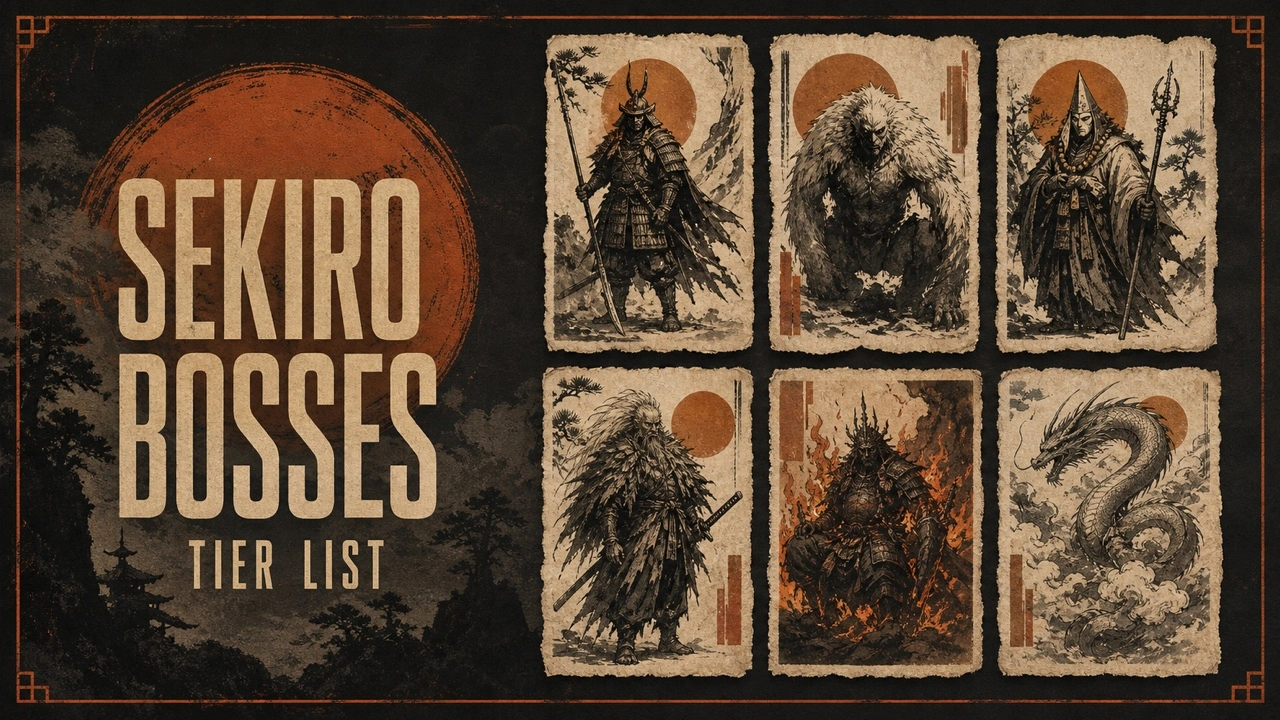
Sekiro bosses feel impossible until the player identifies the rhythm they are teaching. Genichiro asks for forward pressure and lightning reversal. Guardian Ape asks the player to read two very different bodies. Isshin asks for almost every core response across a long final test. Difficulty is the time needed to make those lessons consistent.
Which Sekiro Bosses Belong in S Tier?
Isshin, the Sword Saint is the hardest broad story boss because his multi-phase fight tests sword deflection, perilous counters, range, projectiles, lightning, and endurance. Demon of Hatred and Owl Father join S tier through a different movement plan and a fast shinobi mirror match that punishes hesitation.
This ranking covers a normal first playthrough. It keeps Inner gauntlet variants and mini-bosses separate and contains boss and route spoilers.
How were these rankings decided?
The list measures Sekiro main bosses for players comparing first-playthrough difficulty without mixing in gauntlet-only Inner variants. Its main rule is a first standard playthrough without Kuro’s Charm restrictions, with mandatory and major optional bosses clearly separated. Each entry is checked against the four topic-specific standards below.
Execution demand
Deflection timing, perilous counters, movement, and healing discipline determine how hard a clean attempt is.
Phase pressure
Long fights and major move-set changes make learning and consistency harder.
Punish clarity
A fair boss teaches where to attack, while unclear camera or arena pressure adds difficulty of another kind.
Progression point
An early boss is judged against the skills and tools a new player is likely to have.
Why does each choice belong in its tier?
Why is S tier placed here?
Isshin tests nearly every core skill over several phases. Demon of Hatred demands a different movement-heavy plan, while Owl Father punishes panic, healing, and predictable attacks with a fast shinobi mirror match.
Entries: Isshin, the Sword Saint, Demon of Hatred, Owl Father.
Why is A tier placed here?
These fights have dangerous phase changes and clear punish rules. Their move sets are demanding, but repeated practice exposes a more stable answer than the S-tier marathons.
Entries: Isshin Ashina, Great Shinobi Owl, Guardian Ape, True Corrupted Monk.
Why is B tier placed here?
Genichiro and Lady Butterfly are major skill checks at their point in progression. The Headless Ape duo is harder to control because two bodies can disrupt camera and spacing.
Entries: Genichiro Ashina, Lady Butterfly, Headless Ape.
Why is C tier placed here?
Gyoubu teaches early deflection and grappling, while the Monkeys and Divine Dragon focus on puzzle or spectacle more than sustained execution.
Entries: Gyoubu Oniwa, Folding Screen Monkeys, Divine Dragon.
Why is D tier placed here?
Mist Noble is intentionally a brief encounter after the surrounding area creates most of the pressure.
Entries: Mist Noble.
Why does Genichiro improve most players?
Genichiro blocks passive habits. Giving him space allows arrows and resets, while steady attacks force predictable deflections and counters. His thrusts and sweeps teach the player to identify perilous animations. His final phase turns lightning reversal into an offensive opportunity.
That is why his first-playthrough placement can be high even though experienced players defeat him quickly. The boss sits at the point where many players stop treating Sekiro like a dodge-focused action game and start controlling posture through attack and deflection.
Why does Demon of Hatred feel like a different game?
The Demon is large, uses wide fire attacks, and often rewards sprinting toward a safe angle more than standing in a sword rhythm. The fire umbrella can protect and create punishes, while Malcontent provides limited control. Grapple prompts help close distance after certain moves.
He still uses Sekiro’s tools, but he tests movement, spacing, and resource planning more heavily than most duels. Calling the fight different is fair. Calling it impossible without learning its own rules misses the same process every major boss demands.
Which Sekiro difficulty lists mix incompatible challenge rules?
- Combining Inner gauntlet variants with story bosses.
- Ranking a late-game boss without accounting for the skills learned before it.
- Calling Demon of Hatred unfair because its movement plan differs from sword duels.
- Using New Game Plus attack power and prosthetic upgrades for a first-playthrough board.
How do Charmless and Demon Bell change the order?
Sekiro balance is stable. The order changes with Charmless, Demon Bell, New Game Plus, speedrun, no-upgrade, or hitless rules, so each challenge needs its own board.
Turn this Sekiro main bosses ranking into a personal board for players comparing first-playthrough difficulty without mixing in gauntlet-only Inner variants with the free RespawnGuide tier list maker. If letter grades hide an important difference, choose descriptive tier labels that state this topic’s scoring rule clearly.
What are the most common questions?
What is the hardest boss in Sekiro?
Isshin, the Sword Saint is the hardest broad first-playthrough test because of his length and move-set range. Demon of Hatred or Owl Father may be harder for a player whose style conflicts with them.
Is Demon of Hatred an optional boss?
Yes. He is a late optional boss and can be missed, but defeating him rewards a major story conclusion and a demanding fight.
Are Inner bosses included?
No. Inner variants belong to the Reflections and Gauntlets of Strength and have changed move sets, so they need a separate difficulty list.
Which Sekiro boss is the hardest?
Isshin, the Sword Saint is the most complete final test. Demon of Hatred is hardest for players who prefer sword rhythms, and Owl Father is hardest for players who heal or attack predictably. Genichiro is the most important teacher. Separate Inner variants, Charmless, and Demon Bell before comparing another player’s order.